Enterprise AI Platform Comparison: Google Cloud vs AWS vs Azure 2026
Read by leaders before markets open.
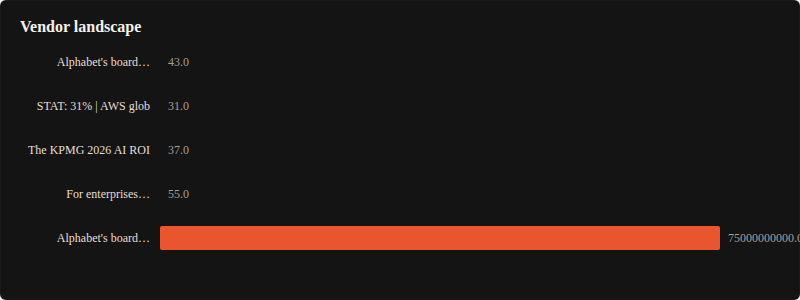
Alphabet's board approved $75 billion in 2026 capital expenditure, a 43% increase over 2025 levels, betting that enterprises will consolidate AI infrastructure spending on Google Cloud. That bet intensifies an already fierce competition in which AWS and Microsoft Azure are each spending at comparable scale.
The three platforms now offer overlapping but meaningfully different AI capability stacks. For a CIO making a platform consolidation decision in 2026, choosing wrong means three to five years of switching costs, compliance gaps, and inference bills that erode the business case before the first model ships to production.
This profile scores Google Cloud (Vertex AI and Gemini), AWS (SageMaker and Bedrock), and Azure (Azure OpenAI Service and Copilot) on five dimensions that matter in production deployments: inference latency and cost, foundation model selection, MLOps tooling maturity, regulatory compliance coverage, and vendor lock-in risk.
What Are the Architectural Differences Between Google Cloud, AWS, and Azure AI Stacks?
Each hyperscaler packages its AI platform differently, and these structural distinctions drive real-world performance, cost, and compliance outcomes for enterprise deployments. Google Cloud centers on Vertex AI for managed MLOps and Gemini for foundation models. AWS splits workloads across SageMaker for custom training and Bedrock for managed foundation model APIs. Azure embeds AI natively into the Microsoft product suite via Azure OpenAI Service and Copilot, making it the most product-integrated of the three.
Google Cloud's AI stack centers on Vertex AI, a managed MLOps platform, and Gemini, Alphabet's flagship foundation model family. Vertex AI consolidates model training, deployment, and monitoring into a single control plane. Gemini 1.5 Pro and Gemini 2.0 integrate natively, and Google's TPU v5 hardware gives the platform a cost-per-token advantage on large-scale inference workloads.
AWS structures its offering in two layers. SageMaker handles custom model training and MLOps for teams building proprietary models. Bedrock sits above it as a managed foundation model API service, offering access to Anthropic's Claude family, Meta's Llama series, Mistral, Amazon's own Titan models, and others. Enterprises already running on AWS infrastructure rarely leave, and Bedrock's model breadth is the platform's primary differentiator.
Azure's AI stack is the most product-integrated of the three. Azure OpenAI Service provides exclusive early access to GPT-4o and o-series models. Microsoft Copilot embeds AI directly into Microsoft 365, Dynamics, and GitHub. For enterprises already standardized on Microsoft's software stack, Azure's integration depth is unmatched. The trade-off is architectural: Azure AI is optimized for Microsoft product workflows, not for bespoke model development.
How Does Each Enterprise AI Platform Perform at Production Scale?
At production scale, the architectural differences between Google Cloud, AWS, and Azure translate into concrete inference latency gaps, diverging token pricing, and total cost of ownership structures that can shift platform economics by 30% or more at high volume. Google's TPU infrastructure leads on long-context throughput; AWS Bedrock varies by provider; Azure GPT-4o is competitive but has documented peak-period availability constraints.
On inference latency, Google's TPU infrastructure delivers competitive throughput for Gemini models, particularly on long-context tasks. Google Cloud reports that Gemini 1.5 Pro processes up to one million tokens per context window, which matters for enterprises summarizing large document sets. AWS Bedrock's latency varies by model provider because compute sits with the underlying model host, not exclusively on AWS silicon. Azure's latency on GPT-4o is competitive, but enterprise customers have documented availability constraints during peak periods in Microsoft's own community forums.
On pricing, all three platforms use token-based consumption models for foundation model APIs, but the cost structures diverge at volume. AWS Bedrock prices Claude 3.5 Sonnet at $3 per million input tokens and $15 per million output tokens, as of early 2026. Azure OpenAI Service prices GPT-4o at $2.50 per million input tokens and $10 per million output tokens at standard throughput. Google Cloud prices Gemini 1.5 Pro at $1.25 per million input tokens for prompts under 128,000 tokens, rising to $2.50 above that threshold. At high volume, Google's pricing is the most aggressive, though enterprises must factor in egress costs and committed-use discounts that each vendor structures differently.
Who Actually Uses Each Platform and Why
Named enterprise examples clarify which platform fits which operational profile.
Goldman Sachs standardized on Google Cloud for its AI development workloads, citing Vertex AI's MLOps tooling and BigQuery integration as primary reasons. The firm runs custom model fine-tuning pipelines that require tight data lineage controls, which Vertex AI supports natively.
Siemens runs its industrial AI workloads on AWS, using SageMaker for custom model training and Bedrock for rapid prototyping with Anthropic's Claude. The manufacturing use case benefits from AWS's breadth of IoT and edge integrations through AWS IoT Greengrass.
JPMorgan Chase uses both Azure and AWS. It relies on Azure OpenAI Service for internal Copilot deployments integrated with Microsoft 365, while running proprietary risk models on AWS SageMaker. The dual-cloud posture is common among large financial institutions that refuse to accept single-vendor dependency.
KEY TAKEAWAY: No hyperscaler wins on every dimension. Enterprises with deep Microsoft software estates will extract the most near-term value from Azure. Teams building proprietary models at scale should evaluate Google Cloud's TPU economics. Enterprises that need maximum model optionality without committing to a single foundation model vendor should default to AWS Bedrock.
How Does AI Compliance Coverage Compare Across Hyperscalers?
Compliance coverage across Google Cloud, AWS, and Azure is broadly comparable at the certification level, but implementation details create meaningful differences for regulated industries. Azure leads on EU data residency maturity, holding a roughly two-year head start over Google Cloud's Assured Workloads in European sovereign infrastructure. AWS GovCloud remains the strongest option for US federal and defense workloads. Only 37% of enterprises report confident alignment between their AI platform choices and their regulatory obligations, according to the KPMG 2026 AI ROI survey.
All three platforms hold SOC 2 Type II, ISO 27001, FedRAMP High (for government workloads), HIPAA eligibility, and PCI DSS compliance certifications. The differentiators emerge at the data residency and sovereignty layer.
Azure's sovereign cloud regions, designed for EU data residency requirements under the EU AI Act and GDPR, are more mature than Google's or AWS's equivalent offerings, according to Microsoft's 2025 compliance documentation. For European financial institutions managing the EU AI Act's high-risk AI system requirements, Azure's sovereign infrastructure reduces implementation risk. AWS GovCloud regions remain the strongest option for US federal and defense workloads. Google Cloud's Assured Workloads product is competitive but younger than AWS GovCloud.
For enterprises evaluating AI compliance posture in detail, the EU AI Act Enforcement compliance banking guide provides implementation-level detail on what regulators are checking in 2026.
Enterprise AI Platform Compliance Confidence by Industry 2026
The KPMG 2026 AI ROI survey found that only 37% of enterprises report confident alignment between their AI platform choices and their regulatory compliance obligations, according to The Register's April 2026 coverage of the report. That gap is largest in financial services and healthcare, where platform compliance infrastructure directly affects audit outcomes.
Should CIOs Use AWS Bedrock or Azure OpenAI for Regulated Industries?
For regulated industries, Azure OpenAI Service leads on compliance infrastructure maturity, but AWS Bedrock leads on model diversification that reduces single-model risk. The right choice depends on whether your primary compliance pressure is data residency (Azure leads) or model portfolio breadth for regulatory review (AWS leads). Neither platform is categorically superior: the decision hinges on geography and governance requirements.
Regulated financial institutions and healthcare organizations face two compliance pressures simultaneously: data residency requirements and model explainability requirements. Azure wins on data residency in Europe. AWS wins on model portfolio breadth, which matters when regulators require an institution to demonstrate it evaluated multiple model providers before deploying a high-risk AI system.
Google Cloud sits between the two. It is stronger on custom model development for teams that want full control of their training pipelines, but less mature than Azure on sovereign infrastructure and less diverse than AWS on third-party model access.
Vendor Lock-in Risk: The Dimension Most Enterprises Underestimate
Lock-in risk is the dimension most platform evaluations minimize and most enterprises regret ignoring.
Azure's lock-in risk is highest for Microsoft-stack organizations. When AI capability embeds into Microsoft 365 Copilot, Dynamics, and GitHub Copilot, migration to another platform requires re-implementing workflows across every product, not just swapping an API endpoint. That integration depth is Azure's competitive moat, but it is also a switching cost that compounds over time.
AWS Bedrock's model-agnostic approach is the strongest architectural choice for enterprises that want to preserve optionality. Because Bedrock supports multiple foundation model providers through a consistent API, enterprises can switch underlying models without changing application code. The risk with AWS is SageMaker's complexity: the platform's breadth makes it powerful for data science teams but operationally expensive for organizations without dedicated MLOps staff.
Google Cloud's lock-in risk is moderate. Vertex AI uses standard Kubernetes-based infrastructure, and model artifacts are portable. The primary lock-in vector is TPU dependency: workloads optimized for Google's custom silicon are difficult to migrate to GPU-based infrastructure on AWS or Azure without retraining and performance re-benchmarking.
Risks and Limitations Every Buyer Should Acknowledge
The marketing materials for all three platforms obscure four risks that surface consistently in production deployments.
First, inference cost projections are unreliable at scale. Token-based pricing looks predictable in pilots but diverges from budgets when production workloads involve longer context windows, higher concurrency, or multimodal inputs. Enterprises should model at three times their pilot consumption before committing to a platform.
Second, MLOps tooling maturity is uneven within each platform. SageMaker's pipeline orchestration is mature; its model registry is less so. Vertex AI's feature store is strong; enterprise reviews have flagged its batch prediction latency as inconsistent. Azure ML's AutoML is well-developed; its support for non-Microsoft model formats requires additional configuration.
Third, support quality degrades at the account level. Enterprise support contracts on all three platforms promise fast response times, but AI-specific technical knowledge in support teams is inconsistent. Enterprises report faster resolution on foundational infrastructure issues than on AI-specific MLOps problems, according to community feedback aggregated by TechTarget's 2026 enterprise AI infrastructure survey.
Fourth, model deprecation risk is real and underappreciated. Azure OpenAI Service retires model versions on Microsoft's schedule, not the customer's. GPT-3.5 Turbo deprecation in 2025 forced enterprises to accelerate migrations they had not planned. All three platforms have model lifecycle policies that require active management.
For enterprises evaluating AI infrastructure investments against ROI frameworks, the enterprise AI ROI analysis covering four practices that unlock 55% returns provides complementary perspective on how platform costs compound against business outcomes.
Hyperscaler AI Infrastructure CapEx 2022-2026
Our Assessment: Which Platform Fits Which Organization
The verdict depends on two variables: existing infrastructure and AI strategy maturity.
Adopt Azure now if your organization runs Microsoft 365 enterprise licenses, uses Dynamics for ERP, and wants AI embedded into productivity workflows within the next 12 months. The Copilot integration is the fastest path from zero to measurable AI productivity gains for knowledge worker functions. Accept the lock-in as a deliberate choice, not an oversight. For AI governance questions that arise from that adoption, our analysis of AI vendor due diligence practices is the relevant starting point.
Adopt AWS Bedrock now if your organization already runs on AWS, wants model optionality, and has the MLOps staff to manage SageMaker's complexity. AWS is the strongest choice for enterprises that expect to cycle through foundation model providers as the model market evolves. Bedrock's consistent API layer is the most defensible architecture for that strategy.
Adopt Google Cloud now if your organization runs high-volume, long-context inference workloads where per-token cost is a primary constraint, or if you need tight integration between AI development and large-scale analytics on BigQuery. Google's TPU economics are most favorable at scale, and Vertex AI's data lineage tooling is the strongest of the three for enterprises with strict model governance requirements.
Wait on Google Cloud if your compliance team requires mature EU sovereign infrastructure today. Assured Workloads is advancing rapidly, but Azure Sovereign Regions hold a two-year maturity lead in European regulated industries.
Wait on Azure OpenAI Service if your AI strategy requires model flexibility. GPT-series exclusivity is a feature until OpenAI releases a model that does not meet your requirements, at which point it becomes a constraint.
The data AI platform comparison published in April 2026 covering Palantir, Databricks, and Snowflake is the complementary read for enterprises deciding how their hyperscaler choice intersects with their data platform strategy, a decision that is increasingly inseparable from the AI platform choice itself.
What to Watch Over the Next 12 Months
Three developments will alter this comparison before year-end.
Google's Gemini 2.0 Ultra rollout to enterprise customers, expected in mid-2026, will test whether Google's pricing advantage holds at higher capability tiers. AWS's planned expansion of Bedrock's agent orchestration capabilities will determine whether it can close the gap on Azure's workflow integration depth. The EU AI Act's first enforcement actions, expected in Q3 2026, will clarify whether Azure's sovereign infrastructure lead translates into a genuine compliance advantage or a marketing claim.
CIOs running platform evaluations today should plan a checkpoint at Q4 2026 before finalizing three-year committed-use agreements. Competitive dynamics are moving fast enough that a six-month delay in signing carries less risk than locking into pricing structures the market has not yet stress-tested.
Sources
- Alphabet, "Q4 2025 Earnings Release," February 2026. https://abc.xyz/investor/
- Synergy Research Group, "Cloud Market Share Q4 2025," January 2026. https://www.srgresearch.com/
- The Register, "KPMG AI ROI Survey Coverage," April 2026. https://www.theregister.com/2026/04/10/ai_roi_kpmg/
- TechTarget, "GenAI Data Center Infrastructure Enterprise Survey," 2026. https://www.techtarget.com/searchenterpriseai/feature/GenAI-data-center-infrastructure-reshapes-business-processes
- IBTimes Australia, "Alphabet Stock and 2026 CapEx Coverage," 2026. https://www.ibtimes.com.au/alphabet-stock-edges-higher-ai-momentum-cloud-surge-offset-massive-2026-capex-concerns-1866093
- Microsoft, "Azure Compliance Documentation," 2025. https://learn.microsoft.com/en-us/azure/compliance/
Frequently Asked Questions

Enterprise AI Vendor Due Diligence: Anthropic IPO
Enterprise AI vendor due diligence gaps exposed by Anthropic's withheld model. Fewer than 30% of firms audit vendors. 3 contract clauses that protect your organization.

CFO AI Investment Framework: Why Waiting Costs Millions
CFO AI investment framework: 74% of AI pilots never document ROI per Gartner. Learn why finance leaders must govern AI vendor and spend decisions now.

Walmart AI Supply Chain: How It Cut Costs 40%
Walmart AI supply chain eliminated 30M driving miles, saved $55M with Self-Healing Inventory, and cut delivery costs 40%. A COO blueprint for enterprise AI ops.