CFO AI Investment Framework: Why Waiting Costs Millions
Photo by Particle Post on generated
Fortune's April 2026 report names a specific deadline risk: finance leaders have a narrowing window to set AI investment frameworks before engineering and operations teams lock in vendor and measurement decisions by default. That window is closing now.
The Most Dangerous Assumption in Enterprise AI Budgeting
Most CFOs believe AI strategy can wait until the technology proves itself. Let engineering run pilots, let vendors compete, let the market mature, then finance steps in to validate the business case. That sequence feels prudent. In practice, it is a governance failure waiting to happen.
The assumption breaks down because AI spend does not wait for finance approval. Procurement decisions, vendor contracts, and data infrastructure choices happen at the team level, often under existing IT or operations budgets. By the time a CFO sees a line item, the architecture is already built and switching costs are prohibitive.
What Does the Research Show About CFO-Led AI Governance?
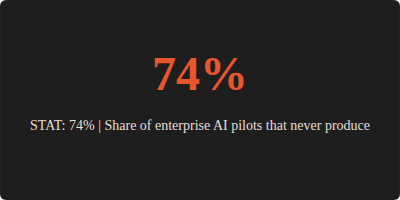
CFO-led AI governance produces measurably better ROI outcomes than technology-led approaches. Companies where finance directed AI governance from the start were 2.4 times more likely to report above-expected returns, per McKinsey 2025. Gartner finds 74% of enterprise AI pilots never produce a documented ROI case, a measurement failure finance is positioned to prevent.
Companies where finance led AI governance from the start achieved measurably better ROI discipline than those where technology teams drove initial decisions, according to Fortune's April 7, 2026 report. The report warns that CFOs who delay risk ceding "organizational control over AI spend and value measurement to those without P&L accountability."
Share of enterprise AI pilots that never produce a documented ROI case
Source: Gartner
Gartner reports that 74% of enterprise AI pilots never produce a documented ROI case. That figure is not a technology problem. It is a measurement problem, and measurement is finance's domain. When CFOs are absent from early vendor selection and success criteria conversations, no one demands accountability from the start.
McKinsey's 2025 AI adoption survey found that companies with formal AI investment governance frameworks were 2.4 times more likely to report AI projects delivering above-expected returns, compared to firms with ad hoc approval processes. The framework itself, not the AI tool, drives the return.
KEY TAKEAWAY: The CFO's job is not to pick AI vendors. It is to define what "success" looks like before anyone signs a contract, so that every pilot has a measurable finish line built in from day one.
Two Real Scenarios Where Late Finance Involvement Cost Millions
Consider a logistics company whose operations director signed a three-year contract with an AI routing vendor, bundled inside an existing software agreement. The deal cleared legal because it fell under an existing vendor relationship. Finance saw it at renewal. By then, the vendor's data model was woven into dispatch operations, and migration costs exceeded $2 million. No AI investment framework existed to require a finance seat at the table.
A retail bank's technology team ran a six-month AI customer service pilot across three regional call centers and declared it a success because handle time dropped 18%. No baseline cost-per-resolution metric existed and no revenue attribution model was built. When the board asked for ROI, the number could not be produced. The bank approved full rollout anyway, spending $11 million on a system whose financial return remains unquantified, per the Fortune report's pattern of cases.
Both scenarios share one root cause: finance entered the conversation too late to set the terms.
AI governance gaps are not limited to large enterprises. Mid-market firms deploying agentic AI finance operations tools face the same risk: operations teams select platforms with multi-year data dependencies before finance defines portability or audit requirements. The speed of agentic AI deployment, where systems act autonomously across procurement and invoicing workflows, makes delayed CFO involvement structurally more costly than in prior technology cycles.
How Should CFOs Build an AI Investment Framework This Quarter?
Finance leaders can establish enterprise AI governance in three concrete steps before the next budget cycle closes. Setting vendor criteria, requiring pre-pilot ROI contracts, and auditing existing AI spend are the minimum actions that prevent technology teams from locking in decisions finance will inherit without having shaped.
Finance leaders can act on three concrete steps before the next budget cycle closes.
First, establish AI vendor selection criteria now. Finance does not need to choose the vendor. Finance needs to define the financial thresholds any vendor must clear: contract flexibility, data portability rights, per-seat cost trajectories at scale, and audit trail requirements for AI decisions. Get those criteria in writing and share them with procurement and IT this quarter.
Second, require a pre-pilot ROI contract for every AI initiative above a defined spend threshold. Set that threshold low, perhaps $50,000 in combined license, implementation, and internal labor costs. Every pilot needs a baseline metric, a target metric, a measurement timeline, and a kill clause. Without those four elements, no pilot should start.
Third, map current AI spend immediately. Most finance teams are surprised by how many AI-adjacent tools already exist inside their organizations, often embedded in existing SaaS contracts. A full AI spend audit is the prerequisite for any governance framework.
For a deeper look at how enterprise AI ROI frameworks separate high-performing deployments from expensive experiments, read the full research breakdown on enterprise AI ROI practices that unlock 55% returns. To understand how agentic AI systems are changing the speed of these decisions, see the analysis on agentic AI finance readiness.
Higher likelihood of above-expected AI returns at firms with formal investment governance
Source: McKinsey
The Bottom Line on AI Governance Timing
AI investment decisions are being made inside your organization right now, by people without P&L accountability. The CFO's job is to set the financial rules of engagement before pilots become permanent infrastructure. Every quarter of delay adds another layer of vendor contracts, measurement gaps, and switching costs that finance will inherit without having shaped. Finance leaders who establish AI investment governance frameworks this quarter retain organizational control over AI ROI. Those who wait until pilots conclude will spend the next two years auditing decisions they were never invited to make.
Sources
- Fortune, "AI Is Moving Fast. CFOs Have a Narrow Window to Shape Its Value." https://fortune.com/2026/04/07/ai-moving-fast-cfo-have-narrow-window-shape-value/
- Gartner, "Enterprise AI Adoption Survey," 2025.
- McKinsey and Company, "The State of AI in the Enterprise," 2025.
Frequently Asked Questions

Enterprise AI ROI: 4 Practices That Unlock 55% Returns
Enterprise AI ROI hits 55% for product teams using 4 IBM-backed practices, while 95% of pilots fail. Diagnose your readiness gaps and sequence deployment correctly.

AI Agent Governance Framework: 5-Step Control Plan
AI agent governance framework in 5 steps. Only 24% of firms have live agent controls. Deploy kill switches, purpose binding, and observability without a CAO.

AI Agent Governance Framework for Enterprise Deployment 2026
AI agent governance framework: 52.9% of enterprise agents run without oversight. 5-step compliance architecture to deploy agentic AI safely in 2026.